

After 122 years in the same family, a remote King Country farm changed hands in the autumn.
In 1904 William John Mackenzie, originally from the Scottish Highlands, was allocated 325 hectares in the Waitewhena Valley, Ōhura. He won the right to farm the property on a 999-year lease, awarded by ballot.
Densely covered and unforgiving, the country presented an enormous challenge, as Will’s granddaughter Lorna Gribble explains.
“Initially the road only existed on a map and access to the property was by foot. Will’s sole income was from government road building, turning the pack track into a dray road. Until the tracks were widened for cart horses, all supplies were brought in on horseback.”
At first, they lived in tents and basic punga and slab whares.
“Like all early settlers, his aim was to clear enough of the block to become self-sufficient with cows and sheep.”
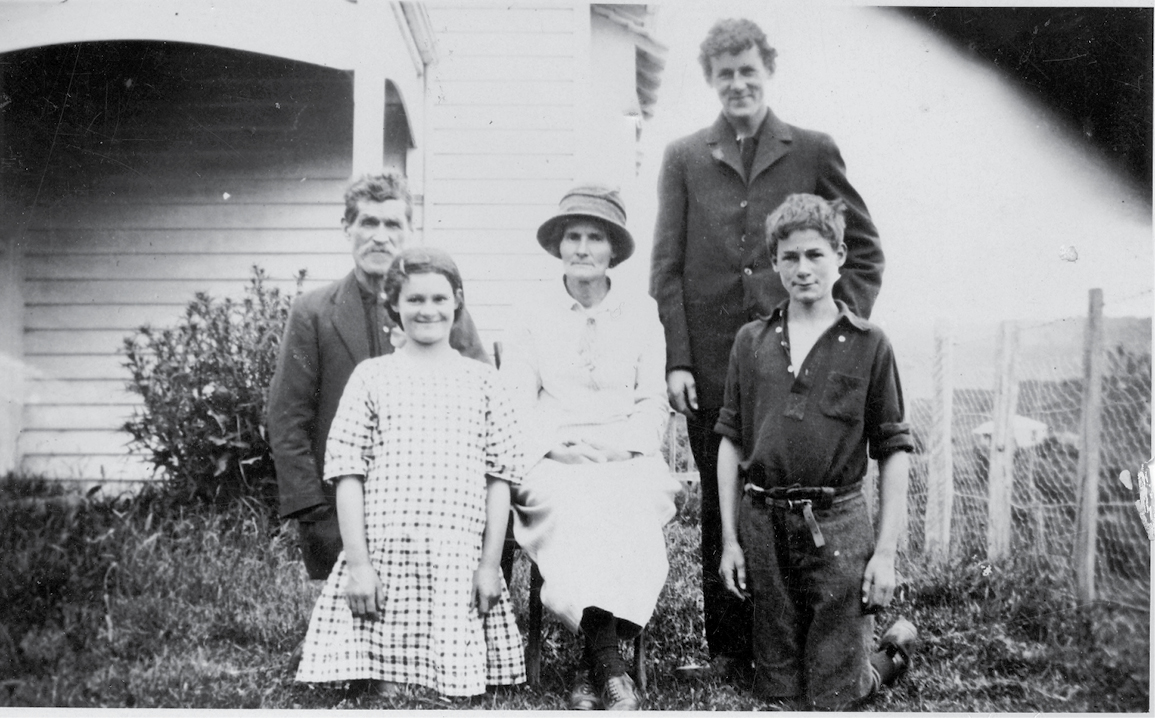
Pictured: WJ & Ellen Mackenzie and family 1928
In 1912 Will married Ellen Gulson from Goulburn, Australia. They had three children: Lorna’s father Ian, his brother Doug and sister Bessie.
Isolation was the biggest challenge.
“They attended one-room Waitewhena School. Their teacher also serviced neighbouring Hapurua Valley, riding between the two and sometimes only teaching three days a week.”
While at first stock flourished on the newly developed land, once the natural fertility was taken up, they struggled, and the property tended to revert to fern and scrub. Dairying began around 1922.
“From a herd of 30 shorthorns, they sent cream to the Matiere dairy factory,” says Lorna.
Will’s death in a 1929 accident left his widow with three teenage children and a £2000 mortgage. Along with many others, they found the 1930s tough.
“Prices for butterfat and wool were hardly enough. Will, then later Ian and Doug, spread fertiliser by hand.”
Ian later told Lorna that, unlike some neighbours, the family never walked off the farm because, with Will dead and Ellen’s family in Australia, they had nowhere else to go. Ian and Doug took turns working off the farm, labouring and droving.
Doug enlisted in 1940, though was captured after the fall of Crete and spent several years as a prisoner of war. Ian was classified as an essential worker while Bessie became a land girl and married out of the district.

Pictured: Loading wool at the Mackenzie farm near Ōhura, circa 1940s to 1950s.
When Doug returned, he and Ian forged a farming partnership, purchasing neighbouring land. Between the early 1940s and mid-1950s they bought eight adjoining properties, expanding the farm beyond 2200 hectares. In 1948 Ian married Bathie Luttrell, from Whakatāne. Lorna’s brothers Colin and Stuart were born in 1949 and 1951, while she arrived in 1954.
“In the valley and around Ōhura township, every block was run down. None were economic, so the brothers worked long, hard hours, investing income back into the land,” says Lorna.
After so many decades of struggle, the Korean War wool boom turned the Mackenzies’ fortunes around. They increased farm development, fertiliser, tracking, fencing and bridge construction. Farm labour became essential.
“Workers usually lived in our home and often left to take up their own farms. Most stayed in touch. My parents and Doug were proud to give several young men the opportunity to start successful farming careers,” she says. Colin followed the same path, mentoring the next generation.
For several decades and two generations, one or another of the Mackenzie family served on virtually every local committee or board, including the county council, RSA, sporting clubs, Plunket, PTA, A&P association and museum.
“The only committee they weren’t on was the Catholic church, and that’s because we were Anglicans,” says Lorna.
Bathie was also the local reporter for several newspapers, including the NZ Herald, attending events with her trusty Box Brownie camera to gather information and results.
Coal from the valley was extracted through several opencast mines, including from 1956 a mine on the farm later known as the Plateau Colliery.
“With no other children nearby, the coalmine became our playground. If Harry, the mine manager, was detonating explosives, we had to sit on a knoll until he could see us. It was fun.”
The Mackenzies were granted freehold of the farm in the 1980s.
After Doug died in 1988, Bathie and Ian retired to Te Kuiti. Stuart farmed separately, while Colin retained the home farm, by then totalling 2446 hectares. Colin died in 2004, leaving this expanded farm to a family trust, administered by Lorna and Stuart, who were active on the farm, in collaboration with a long-term lessee.

Pictured: Stuart Mackenzie and Peter Wylie’s sales assistant Glynn Meads.
Deciding to sell, in February 2026 they brought in Peter Wylie of PGG Wrightson Real Estate, King Country, to offer the farm to the market.
“This well-scaled property offers the scope to run large numbers of stock, with flexibility to either retain them on farm or finish them elsewhere. Such an excellent property will always attract plenty of attention, and positivity around sheep and beef enabled us to find a ready market and a willing buyer,” says Peter.
Although the Mackenzies have left the farm, they wrote the right to come back for visits to their family legacy into the sale agreement.
“We are proud of what the family achieved on the property, and grateful that the new owners are willing for us to return occasionally to enjoy the views and reminisce,” says Lorna.



Related posts
Back to News & Publications


